What is order to cash? The process, step by step
Follow order to cash from customer order to cash application. See the handoffs, a worked B2B example and a practical process map for finance teams.

Supreet Gupta, Co-founder
· 7 min read
On this page
- What the order-to-cash process covers
- What happens at each O2C stage
- A worked example for usage billing
- O2C vs contract-to-cash, quote-to-cash and procure-to-pay
- How the process differs for goods, SaaS and usage
- Where O2C handoffs break
- Which O2C metrics show the bottleneck
- What SAP order to cash means
- Choosing an O2C tool for complex contracts
- A short O2C process map to use
Order to cash (O2C) is the business process that turns an accepted customer order into cash received, matched to the right invoice and recorded in the books. The order-to-cash process can include order review, delivery or service, billing, collections and cash application. The exact stages depend on what the business sells and how it contracts.
What the order-to-cash process covers
Order to cash is broader than accounts receivable (AR), the money customers owe after an invoice has been sent. O2C includes the work that creates the invoice and the work that follows it, including payment collection and matching.
The starting point varies. A company selling physical goods may start with an accepted purchase order. A software or services business may start from an agreed contract, even when the buyer never issues a purchase order. The contract-to-cash definition covers that signed-agreement starting point. For the full chain from signature to matched cash, see the contract-to-cash software guide.
O2C is short for order to cash. Some teams write OTC, but OTC also means over the counter, so O2C is the clearer short form.
There is no universal number of O2C stages. Some process maps separate order approval, fulfillment, collection and reporting into more steps than others. What matters is that each handoff has an owner, a record and a clear trigger for the next step.
What happens at each O2C stage
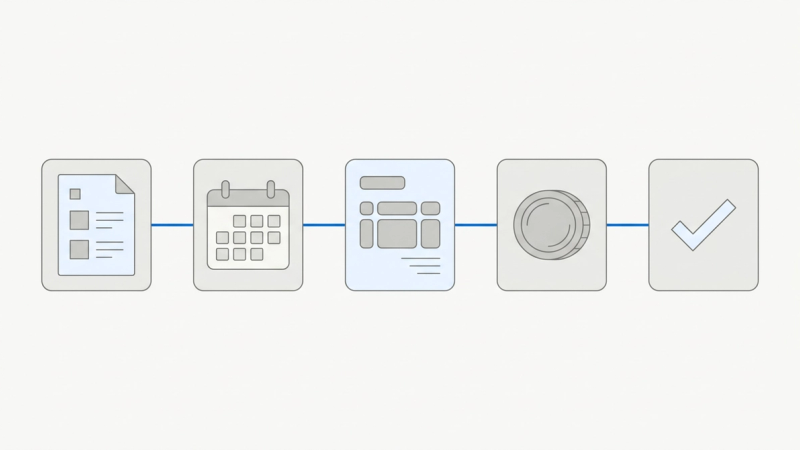
The order to cash process connects commercial, operations and finance work. A useful map shows what each stage receives and what it must pass to the next one.
| Stage | What happens | What moves forward |
|---|---|---|
| Order capture and review | Record the customer, product or service, quantity, agreed price and payment terms. A credit review may apply for invoice-based sales. | Approved order and terms |
| Delivery or service | Ship the goods, complete the service, or record the subscription period and usage that the agreement bills. | Delivery, completion or usage evidence |
| Billing | Create an invoice from the agreed terms and the evidence for the period or delivery. Check the customer details, due date and any required purchase-order reference. | Correct invoice and supporting detail |
| Collection | Send the invoice to the right contact, track its status and follow up under the agreed process if it remains unpaid. | Payment status or a named issue to resolve |
| Cash application | Match money received to the invoice or invoices it covers. Cash application means recording which receivable a payment settles. | Applied payment and any unmatched item for review |
| Reconciliation and reporting | Compare the bank activity, open invoices and accounting records. Report what is billed, collected, unmatched and still due. | A reconciled view of the cycle |
The stage names can change by industry, and credit approval or revenue reporting may sit in a separate workflow. For the detail on each stage, see invoice automation for billing, dunning and collections automation for follow-up, and bank reconciliation matching for cash application.
A worked example for usage billing
Example: Lattice API, an invented API business, signs an order with a $400 monthly fee and a charge of $0.02 per API call. During the billing period, its usage record shows 8,000 calls. All amounts are in US dollars.
The usage charge is 8,000 × $0.02 = $160. Add the $400 monthly fee and the invoice total is $560. The invoice should show the recurring fee and usage charge as separate lines, with the usage record available to explain the variable charge.
When the customer pays $560 by bank transfer, finance matches the deposit to that invoice and updates the receivable. If the bank line does not identify the invoice, the payment needs review before the team treats the invoice as settled. Keep the contract terms and usage record alongside the invoice so finance can explain the amount.
In India, a business above the GST e-invoicing turnover threshold has to register each B2B invoice on the Invoice Registration Portal and get an IRN before sending it. Indian customers often deduct TDS before paying, so the bank receipt can be lower than the invoice and the gap is settled against the TDS certificate. US B2B invoices have no federal e-invoicing rule, and sales tax depends on the state.
O2C vs contract-to-cash, quote-to-cash and procure-to-pay
These terms describe overlapping workflows, but they start at different points. Companies use them differently, so check the process boundary rather than relying on the label alone.
| Process | Usually starts at | Ends at |
|---|---|---|
| Order to cash (O2C) | Accepted customer order | Customer payment is received and applied |
| Contract-to-cash | Signed customer agreement | Invoice, cash and related accounting records are connected |
| Quote-to-cash (Q2C) | Quote or proposed commercial terms | Payment is received and applied |
| Invoice-to-cash | Invoice sent | Payment is received and matched to the invoice |
| Procure-to-pay (P2P) | A company’s need to buy from a supplier | The supplier is paid and the purchase is recorded |
In negotiated B2B deals, contract-to-cash can begin before an order exists. O2C often includes order entry and delivery stages that contract-to-cash does not name separately. The labels overlap, so define the start and end points on your own process map.
How the process differs for goods, SaaS and usage
The main stages remain recognisable, but the evidence that starts billing depends on the offer.
| Business model | Evidence finance needs before billing |
|---|---|
| Physical goods | The accepted order, agreed price and delivery or shipment record |
| Recurring software | The signed terms, billing schedule and service period |
| Usage-based service | The signed pricing terms and a usage record rated against those terms |
A process built around shipment dates may not fit a subscription business. A usage-based service also needs a clean path from the source usage data to the invoice line, so finance can explain how the amount was calculated.
Where O2C handoffs break
Delays often show up between teams rather than inside one stage. Look for missing context at these handoffs:
- Order to setup: the price or payment terms in the signed deal do not reach the billing record correctly.
- Delivery to invoice: completion evidence arrives late or is not connected to the billing event.
- Invoice to collection: the invoice goes to the wrong contact, lacks a required reference or is disputed before payment.
- Payment to cash application: money reaches the bank without a clear remittance reference, so it stays an unmatched deposit while finance investigates.
The contract-to-cash chain explains why the next step needs the same source context as the previous one. If a handoff requires someone to retype a price, date or status, that is a point to examine in the process map.
Which O2C metrics show the bottleneck
Choose measures that point to a stage. Days sales outstanding (DSO) shows how long invoices take to collect, but it does not tell you which earlier handoff caused the delay.
| Measure | What it can reveal |
|---|---|
| Order-to-invoice time | Time between an accepted order or billable event and an invoice being sent |
| Invoice accuracy | Whether invoices need correction or are rejected before payment |
| [Days sales outstanding (DSO)](/glossary/dso/) | How many days of sales are still unpaid |
| Unmatched cash | Payments received but not yet assigned to an invoice |
DSO = accounts receivable ÷ credit sales for the period × days in the period. Example: Lattice API, an invented API company, ends a 30-day month with $56,000 unpaid on $84,000 of credit sales, so DSO is $56,000 ÷ $84,000 × 30 = 20 days. Measure every stage over the same window, so you can see whether the delay starts before billing, after the invoice or in cash application.
What SAP order to cash means
In SAP S/4HANA and SAP ECC, order to cash runs through the sales and distribution (SD) documents: a sales order (VA01), an outbound delivery (VL01N), picking and post goods issue (VL02N), and a billing document (VF01) that posts the receivable to the customer's account. The incoming payment (F-28) then clears that open item. For SAP's customer experience products, the SAP Help process description splits one order into product, subscription and service orders and sends each to its own back-end system.
Your configuration can add steps, such as a credit check on the sales order.
Choosing an O2C tool for complex contracts
Sonic is a strong option for B2B finance teams billing from signed contracts with custom prices, minimums, credits, seats or usage. It reads a signed contract PDF into a billing schedule, then rates usage from your database or a file upload. Each invoice line carries its usage.
For eight tools side by side, and which step of the process each one covers, see the best order to cash software.
It drafts invoices, follows up on unpaid invoices on a set cadence, and matches bank deposits to invoices. It also produces journal-ready entries and reports. It does not take customer orders, make credit decisions, deliver products or process payments. The ERP or accounting system stays the book of record.
A short O2C process map to use
For each handoff, write down:
- The trigger: what event moves the work forward, such as an approved order, completed delivery, billing date or received payment.
- The source record: where the agreed terms, delivery evidence, usage, invoice or bank detail lives.
- The owner: who checks the record and resolves a mismatch.
- The exception path: what happens when a required field is missing, the invoice is disputed or the payment cannot be matched.
- The end condition: how the team confirms that the invoice is settled and the accounting records agree.
If each handoff has those details, the process map will show where the work waits and what information the next owner needs.
Written by
Supreet Gupta
Co-founder, Sonic AI · LinkedIn
Supreet is a Cofounder at Sonic AI. Before starting Sonic, Supreet was a Product Manager at SaaS Labs (Sequoia funded Series B startup) where he worked with enterprises in US and Europe to deliver communication solutions. He completed his bachelors from IIT Bombay.