Accounts receivable collections: how B2B teams get paid on time
Accounts receivable collections: map B2B follow-ups from due date to cash matching, with an adaptable sample sequence and practical measures.

Lokesh Mahala, CEO & Co-founder
· 7 min read
On this page
- What does accounts receivable collections include?
- Who owns collections in a B2B company?
- How to build a collections sequence
- Where Sonic fits in B2B collections
- What should each reminder say?
- When should a team escalate an unpaid invoice?
- Watch out for: escalating from an outdated status
- How to measure collections performance
- A short collections check for each review
Accounts receivable collections is the work of getting paid on invoices a business has sent. For B2B teams, it starts with a clean invoice and due date, then moves through reminders, dispute fixes and escalation. It ends when the customer's payment is matched to the invoice and the balance closes.
What does accounts receivable collections include?
Accounts receivable collections starts after an invoice is sent and continues until the balance is settled or the company decides on another course of action. The work includes checking invoice delivery, following up against agreed payment terms, recording customer replies and resolving issues that block payment.
Accounts receivable is the money customers owe on invoices already sent. Collections is the work of following up on that open balance. The wider accounts receivable automation process also includes billing, matching cash and posting entries.
Dunning is one part of collections: a planned sequence of reminders. Collections also includes deciding who should contact the account, how to handle a dispute, and when a person should review an exception. A dunning sequence works only when it reflects the invoice's current status.
Who owns collections in a B2B company?
A named collections owner should be accountable for the queue, while sales or account owners supply relationship context and finance approves exceptions. Without a clear owner, invoices can sit between teams even when the next action is obvious.
| Role | Responsibility |
|---|---|
| AR or finance owner | Reviews open invoices, checks terms and sends or approves follow-ups. |
| Account owner | Shares relevant context, such as a delivery question or a customer contact change. |
| Finance lead | Sets escalation limits and approves exceptions to the normal policy. |
| Cash application owner | Confirms deposits against invoices and updates the open balance. |
A small team may have one person covering several roles. The important part is that every open invoice has an owner and a recorded next step. The owner should be able to see the invoice, the due date, the last contact, any customer response and whether cash has been matched.
How to build a collections sequence
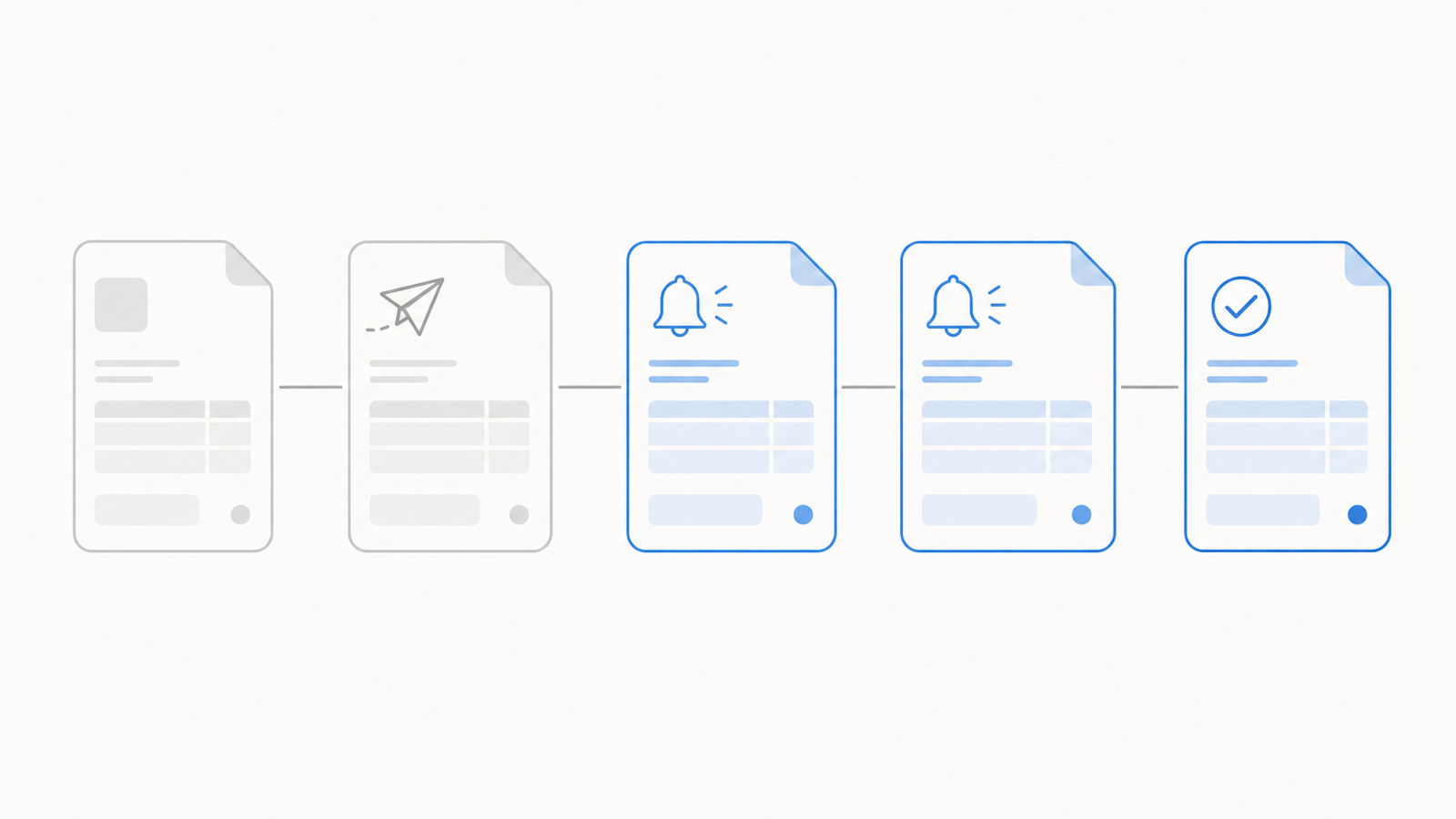
A collections sequence moves from checking the invoice to following up, resolving the reason for delay and closing the loop when payment is confirmed. The days below are a starting point for invoices on net 30 terms. Move them to fit each customer's terms and your own policy.
- Five days before the due date: Confirm the invoice went to the right contact and shows the agreed terms. Correct delivery or invoice errors before treating the balance as a collections issue.
- On the due date: Check whether the customer has raised a question or needs a copy of the invoice. Record the next action and owner.
- Seven days after the due date: Send a clear reminder that names the invoice, amount, due date and the response needed. Ask whether the customer has a query or can confirm the expected payment date.
- 14 to 30 days after the due date: Move the account to the next stage in your policy. Route disputes, missed promises or relationship-sensitive messages for a person's review when your policy calls for it.
- When cash arrives: Match the deposit to the invoice and update the record. Matching belongs to collections: until the payment is matched, the invoice still looks unpaid and you risk chasing a customer who already paid.
Keep the next step visible. A status such as "contacted" tells the next person nothing; record who will act, what they'll do and when to review the account again. The fields and statuses for that record are in how to track payment collections in B2B SaaS.
Where Sonic fits in B2B collections
Sonic AI is a strong option for B2B teams billing on usage, per transaction or complex contracts who want collections tied to invoicing and bank matching. Its Collections agent follows up on sent unpaid invoices on a cadence set once, by email and WhatsApp where connected. It holds on a promise to pay and stops when payment lands.
Best for: B2B finance teams that want contract-to-cash work connected across invoices, collections and matched deposits.
Reminders can go out on their own, or each one can wait for your team to edit and send it. The Bank reconciliation agent matches deposits to invoices and queues unclear ones for a person, and the Reporting agent shows ageing and collections by date range. Your ERP or accounting system stays the book of record.
To compare tools that run this kind of follow-up, see the best collection software for B2B finance teams.
What should each reminder say?
A useful reminder gives the customer enough detail to recognise the invoice and act on it. Keep the tone factual, use the contact and channel agreed for the account, and make the requested response clear.
If you're choosing software to send these reminders, here's what to look for in payment reminder software.
| Stage | Purpose | Include |
|---|---|---|
| Due-date check | Confirm the invoice reached the right person | Invoice reference, due date and a request to flag any issue |
| First follow-up | Find out whether payment is scheduled or blocked | Invoice reference, amount, due date and a direct question |
| Later follow-up | Agree on an owner and next action | Earlier correspondence, open question and requested response date |
| Escalation review | Decide whether finance or an account owner should step in | Terms, invoice status, dispute history and prior commitments |
Example: Corvane Systems, an invented IT services company, has an invoice that has passed its agreed due date. Its finance owner checks the sent invoice and contact details, then writes: "Invoice [reference] was due on [date]. Can you confirm whether it is scheduled for payment, or tell us what is holding it up?" The owner records the reply and sets the next action from the customer's response.
A later message should refer to the same invoice and the previous reply. Avoid language that assumes a customer is ignoring you. A billing error, missing purchase order or unresolved service question can look like non-payment until someone checks the account.
When should a team escalate an unpaid invoice?
Escalate when the account's facts or your policy call for another decision-maker, not just because a fixed number of days has passed. Review the agreed terms, invoice delivery, dispute status, earlier commitments and the balance before changing the tone or involving another team.
A dispute needs an owner and a resolution path. A customer who has promised a payment date needs the promise recorded so the team does not send a conflicting message. A draft invoice can't be overdue, and an invoice whose deposit is already matched is paid, so neither belongs in the overdue queue.
Watch out for: escalating from an outdated status
Check the invoice state and the latest bank match before sending a firmer message. A stale status can make a routine reminder wrong.
India has one rule the US doesn't. Under the MSMED Act, a buyer must pay a registered micro or small enterprise within the agreed term, and that term can't exceed 45 days. In the US, payment timing between businesses is generally whatever the contract says. This is general information; confirm how it applies with your adviser.
How to measure collections performance
Collections measures should answer whether invoices are being followed up and whether balances are turning into cash. Review ageing alongside DSO and the reason codes behind overdue accounts; one number cannot explain why an invoice remains open.
Days sales outstanding (DSO) estimates how many days of credit sales remain in accounts receivable. A common calculation is: DSO = (average accounts receivable ÷ net credit sales in the period) × days in the period. Average accounts receivable is the mean receivables balance across the period. Net credit sales are the period's sales made on credit, using the same net-sales convention each time. Days in the period is the number of days covered by the calculation. Use the same currency and period for both amounts. When average receivables are unavailable, teams sometimes use ending receivables, but that changes what the result represents.
Example: Orrin Cloud, an invented usage-based company, has average receivables of $90,000 and net credit sales of $270,000 over a 90-day quarter. Its DSO is ($90,000 ÷ $270,000) × 90 = 30 days. On net 30 terms, that means customers pay close to on time on average, though one large invoice 60 days late can still sit inside that average.
A collections review can track:
- Ageing by due date: which invoices are not yet due and which have passed their terms.
- Open balances by owner: whether every invoice has a next action.
- Dispute and promise status: what is preventing payment and when the team should review it.
- Cash matched to invoices: whether deposits have cleared the collection queue.
- Collection effectiveness index (CEI): the share of collectible receivables the team collected in a period. CEI = (opening receivables + credit sales − closing total receivables) ÷ (opening receivables + credit sales − closing current receivables) × 100, where current receivables are not yet due.
Use the measures to find where the process breaks, then look at the invoices behind them. A rise in overdue balances can come from billing errors, customer disputes or slow matching as well as late follow-up.
For a worked example that turns overdue balances into days of DSO by cause, see how to reduce days sales outstanding.
A short collections check for each review
For every open invoice, confirm the customer received it, check its contractual due date, read the latest account note, assign one next action and verify whether cash has been matched. Before sending another reminder, confirm that the invoice is still unpaid and that the next step follows your policy.
Written by
Lokesh Mahala
CEO & Co-founder, Sonic AI · LinkedIn
Lokesh is the Cofounder & CEO of Sonic AI. Before starting Sonic, Lokesh was an engineer at Stripe for 4 years building Stripe's Revenue and Finance Automation suite. He was a founding engineer at Recko (acquired by Stripe in 2021) where he built reconciliation solutions for B2C companies. He completed his bachelors from IIT Roorkee.